Land Encroachment in Pakistan: How to Protect Your Property and Get It Back
Many people only find out about an encroachment when it is already there. A neighbour's wall has moved a few feet onto your plot. A farmer has ploughed a strip of your field. A shop has crept onto the footpath or the drain in front of your house. In the beginning it looks small, so people ignore it. Later it turns into a long, expensive dispute.
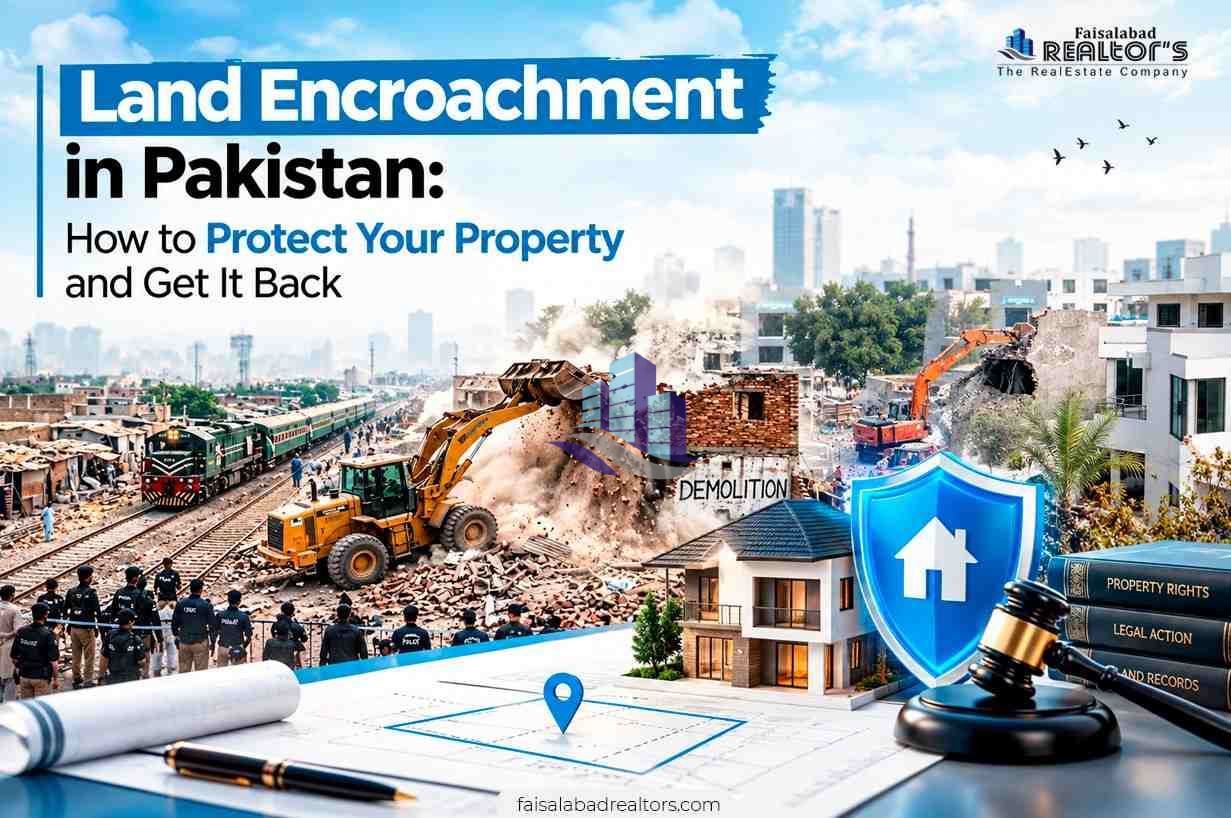
This guide explains land encroachment in Pakistan in simple words. It covers what counts as encroachment, how agricultural land ownership is proved in Punjab, and what steps you can take for property protection, with a focus on Faisalabad and the surrounding tehsils.
What Is Land Encroachment?
Encroachment means someone occupies or uses land that is not theirs, or goes beyond the limit of what they are allowed to use. It can happen on private land or on public land.
Some common examples:
- A neighbour builds a boundary wall a few feet inside your plot
- Someone occupies part of your agricultural field and starts farming it
- A shop extends onto a footpath, road or drain
- A room or shed is built on someone else's land
- Government or public land is occupied without permission
Not every use of another person's land is illegal. A tenant living in rented premises, or a person with a legal right of way, is using the land lawfully. It becomes encroachment when the person goes beyond the right they actually have.
Encroachment and Trespass: What Is the Difference?
The two are related, but they are not the same.
Trespass is entering someone's property without permission. Encroachment is a more lasting intrusion, such as a wall or building that stays on the land. If a neighbour walks into your plot without permission, that is trespass. If he builds a wall that sits partly on your land, that is encroachment. Sometimes both happen together.
Common Types of Encroachment
On private property
This is the most common kind. It usually starts from unclear boundaries, wrong measurements, inheritance arrangements, or deliberate occupation. A wall built a little too far, a room extended over the line, or a neighbour using part of your plot are typical cases.
On agricultural land
In villages around Faisalabad, such as those in Jaranwala, Samundri, Tandlianwala and Chak Jhumra, encroachment often looks different. A neighbouring farmer slowly moves the boundary. A strip along the field edge gets cultivated by someone else. A village path or water channel is blocked or narrowed. These disputes usually come down to revenue records, khasra numbers and field maps.
On public land
Public land includes roads, footpaths, parks, drains and government property. Common examples are shops built out onto footpaths, walls over drains, and buildings on government land.
Among co-owners and heirs
When property is jointly owned or inherited, one person may occupy or build on more than his share. A co-owner who is in possession of a part of joint property cannot simply be thrown out before the property is divided. In such cases, the proper way forward is usually partition, not force.
Agricultural Land Ownership: How Is It Proved?
If you own farmland, you must know which records protect you. In Punjab, ownership and possession of agricultural land are tracked through the revenue record. The main documents are:
- Jamabandi (record of rights): Shows who owns the land, and the area and khasra numbers
- Khasra number and field map: Identify the exact piece of land and its shape
- Mutation (intiqal): Records every transfer, whether by sale, gift or inheritance
- Girdawari: Records who is actually cultivating the land
- Sale deed, gift deed or inheritance papers: Your original title documents
Keep certified copies of all of these. Revenue entries are strong evidence, but a court decides title in a dispute, so your own documents matter just as much.
Two habits protect farmland better than anything else. First, record every inheritance and transfer in the revenue record on time. Many disputes come from old transfers that were never mutated. Second, check the record regularly, especially if you live abroad or in another city, so that nobody changes it or occupies the land without your knowledge.
Punjab has also made the Green Property Certificate compulsory for most property transfers from July 1, 2026. The rollout has been uneven in areas where records are not fully digitised, so confirm the current rule for your tehsil before any sale or transfer of agricultural land.
What to Do When You Find an Encroachment
Stay calm and do not act in anger. Use this order:
- Verify the boundary first: Compare the site with your documents and the field map or approved plan.
- Get official demarcation: In Punjab, this is done through the revenue staff. You apply to the Tehsildar of the tehsil where the land lies, and revenue officers measure the land and mark the boundaries. A demarcation report is useful evidence in any later case. Recent changes in the land revenue law also touch on demarcation, so ask the tehsil office for the current procedure.
- Record the evidence: Take dated photographs and videos, and note names of witnesses.
- Send a legal notice: A lawyer can send a notice asking the person to stop building, remove the structure or vacate. It creates a record that you objected.
- Go to court if it continues: A notice alone does not remove an encroachment.
Legal Remedies for Private Property Owners
The right remedy depends on your situation. A property lawyer will choose it based on your documents and how long ago the encroachment happened.
- Suit for possession under Section 9 of the Specific Relief Act: If someone has forcibly taken your property without lawful process, you can sue for recovery of possession. The court does not decide title in this case. The catch is time. The suit must be filed within six months of being dispossessed. Missing that window is a common and costly mistake.
- Suit for possession based on title under Section 8: This is for when you are the rightful owner, and you need to prove your title. There is no six-month rule, but the general limitation period for recovery of possession is usually 12 years, so do not wait.
- Declaration of ownership: If the other person claims the land is theirs, you may need the court to declare your title.
- Injunction: A temporary injunction can stop further construction while the case is pending. A permanent injunction stops future interference. A mandatory injunction can order removal of something already built.
- Cancellation of fraudulent documents: If the encroacher uses a forged or false document, you may need to challenge it.
- Criminal proceedings: Where there is forgery, fraud, threats, damage or criminal trespass, criminal law can also apply. A plain boundary dispute is normally a civil matter, so do not use a criminal complaint as a shortcut.
The Punjab Property Protection Law
Punjab has recently brought in a stricter law against illegal possession. The Punjab Protection of Ownership of Immovable Property Act 2025 was amended by an ordinance in February 2026. It provides jail terms of up to 10 years and heavy fines for illegal possession of property. It also sets up a Property Tribunal in each district, headed by a serving Additional Sessions Judge, and a scrutiny committee that reviews complaints within a fixed period.
This law is aimed mainly at cases where property is taken by force, fraud or forgery. It may not suit every ordinary boundary quarrel. The 2025 law was also suspended by the Lahore High Court earlier, so the legal position has been changing. Ask a lawyer whether your case fits before you choose this route.
One useful point for buyers: under the amended law, selling or transferring property after a complaint has been filed against it is not allowed and is treated as void. This is one more reason to check for disputes before you buy. Our guide on buying an unapproved plot in Faisalabad covers other checks worth doing.
Encroachment on Public Land
Roads, footpaths, parks and drains belong to the public, and the authorities can act against illegal occupation. In Punjab, the Punjab Enforcement and Regulatory Authority (PERA), set up under a 2024 law, carries out anti-encroachment operations. It also has a public complaint portal. In June 2026 the Chief Minister directed that anti-encroachment drives must be preceded by proper notice and warning to the public.
If you are the one affected by an enforcement action, remember that the authority must work within its legal powers and follow the required procedure. You can challenge action that goes beyond the law. If the encroachment is inside a housing scheme, the Faisalabad Development Authority and local government bodies may also have a role.
Can an Encroacher Become the Owner?
Not automatically. Simply occupying someone's land does not make a person its owner. But long possession can raise legal arguments, especially if the real owner did nothing for many years. Time limits under the law can then work against you.
The lesson is simple. Never ignore an encroachment because it looks small. The longer you wait, the harder your case becomes.
Mistakes That Weaken Your Case
- Waiting too long, especially past the six-month period for a Section 9 suit
- Breaking down the wall or structure yourself, which can lead to a case against you
- Depending on verbal claims instead of records
- Not verifying the boundary before accusing someone
- Filing the wrong type of case
- Naming the wrong person as defendant
- Using the police as a substitute for a civil case in an ownership dispute
How to Prevent Encroachment
Prevention is cheaper than any court case. These simple habits help a lot:
- Mark and fence your boundaries clearly, with pillars or a wall
- Visit the land regularly, or ask a trusted person to do so
- Get the land demarcated when you buy it and keep the report
- Update mutations and revenue records after every transfer or inheritance
- Give tenants written agreements that state their rights and limits
- Avoid leaving land empty for years, especially near roads and growing areas
Overseas owners should be extra careful. The PLRA allows overseas Pakistanis to verify records and use some services remotely, so use these tools and keep a reliable local representative.
Buying Land? Check for Encroachment First
If you are buying a plot or farmland, compare the actual land on the ground with the title documents, the map and the revenue record. A plot that looks big may be smaller on paper, or may already have a neighbour's structure on it. Ask for demarcation before you pay, and visit the site more than once. For a full step-by-step approach, read our property due diligence checklist for Faisalabad buyers.
Frequently Asked Questions
What should I do first if my neighbour has built on my land?
Do not confront him or break the structure. First check your documents and get the boundary demarcated by the revenue office. Then speak to a property lawyer about a notice and, if needed, a court case.
How long do I have to file a case?
It depends on the type of case. For forcible dispossession under Section 9 of the Specific Relief Act, the limit is six months. For recovery based on title, the general period is usually 12 years. Take legal advice immediately, because delay can cost you the remedy.
Can I demolish an encroachment myself?
It is not advisable. Doing so can lead to allegations of trespass or property damage against you. Use the legal process instead.
Who removes encroachment on roads and footpaths?
Local authorities and the Punjab Enforcement and Regulatory Authority handle this. You can also file a complaint through their channels.
Does long possession make someone the owner?
Not automatically, but it can create legal complications. That is why quick action matters.
Do I need a lawyer?
For anything beyond a small, friendly boundary issue, yes. A lawyer can check your documents, choose the right remedy and file within the time limit.
Final Words
Land encroachment in Pakistan is common, but most cases can be prevented or solved early. Keep your agricultural land ownership records clear and updated, verify your boundaries, act quickly when you notice a problem, and follow the legal process instead of taking the law into your own hands. Good records and quick action are the best form of property protection.
At Faisalabad Realtors, we help buyers and owners check land status before they buy, so you know exactly what you are getting. Browse our agricultural land and plots , or contact our team for help with property verification in Faisalabad.
If you're interested in any property sale or purchase, do contact us . We provide the best real estate services in Faisalabad.
Contact us for:
House for sale
House for rent
Room for Rent
Flat for Rent
Ideal Farm House
Commercial Avenues